
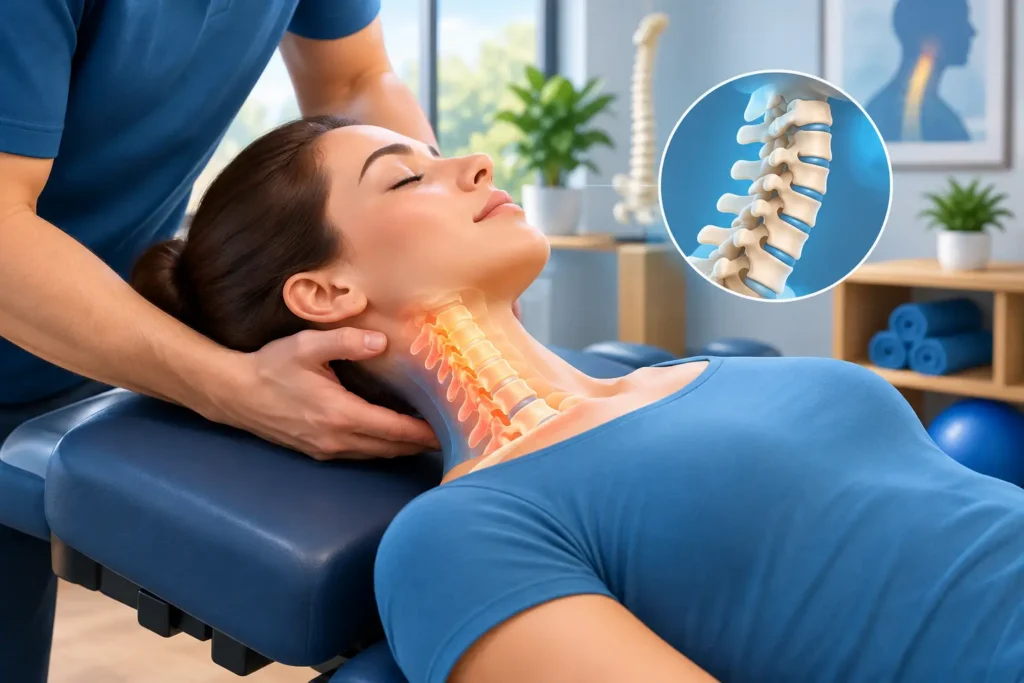
A stiff neck after a long day at a laptop is common. A neck that repeatedly catches when you check your blind spot, sends pain into your shoulder, or triggers headaches is a different problem. Cervical spine therapy is designed to look beyond the painful spot, identify what is limiting healthy movement, and help you return to work, training, sleep, and daily life with more confidence.
The cervical spine is the seven vertebrae in your neck, but neck pain rarely behaves as an isolated neck issue. The head, rib cage, shoulders, upper back, breathing pattern, posture, and even foot mechanics can change how force travels through the body. Effective care accounts for those connections rather than treating every painful neck with the same set of exercises.
What cervical spine therapy is meant to treat
Cervical spine therapy is a personalized physical therapy approach for pain, stiffness, reduced motion, nerve-related symptoms, and movement limitations involving the neck. Treatment may be helpful after an acute strain, after a car accident, or when discomfort has gradually built up over months of commuting, desk work, training, or poor sleep.
People seek care for symptoms such as persistent tightness at the base of the skull, pain turning the head, shoulder blade discomfort, headaches that seem to begin in the neck, and pain or tingling that travels into the arm. Some people feel fine until they lift overhead, run, cycle, or spend an hour looking down at a phone. Others have already tried massage, rest, or generic stretching and found that relief does not last.
The diagnosis matters, but so does the way your symptoms behave. A clinician should assess which movements aggravate pain, which positions reduce it, how your shoulders and thoracic spine move, and whether the nervous system is involved. This creates a treatment plan based on your body and goals, not a one-size-fits-all protocol.
Neck pain is not always a neck-only problem
Your neck is built to be mobile, yet it often compensates when another area lacks movement or control. Limited upper-back rotation can make the cervical spine work harder when you turn. Stiff ribs or poor shoulder blade mechanics can increase strain during overhead lifting. A collapsed foot or altered gait may gradually influence pelvic, trunk, and head position.
This does not mean every episode of neck pain begins at the feet. It means a thorough assessment should stay curious. When pain keeps returning, treating only the tight muscles in the neck may not be enough to change the load that created the problem.
A whole-body assessment before treatment
A productive first visit begins with listening. The details matter: whether pain began suddenly or gradually, what happened around its onset, whether you have had previous injuries, how you sleep, what your workday looks like, and what activities you want to get back to.
The physical assessment may include cervical range of motion, joint mobility, muscle and fascial tension, shoulder and thoracic movement, posture, balance, gait, breathing mechanics, and the way you perform meaningful tasks. For an athlete, that may mean examining a pressing motion or running form. For an office professional, it may mean looking at how the body holds itself through a typical workday and commute.
A good evaluation also distinguishes mechanical pain from symptoms requiring a different level of care. New or worsening arm weakness, loss of coordination, changes in walking, severe unrelenting pain, fever, unexplained weight loss, or symptoms after significant trauma should be assessed promptly by an appropriate medical professional. Physical therapy can be highly effective for many neck conditions, but safety comes first.
How cervical spine therapy can help
The most effective plan usually combines hands-on treatment with active retraining. Hands-on work can reduce guarding, improve tissue mobility, and make movement more comfortable. Therapeutic exercise helps the nervous system and muscles use that improved motion in daily life.
Hands-on treatment for restricted tissues and joints
Functional manual therapy and myofascial release can address restricted tissues around the neck, jaw, shoulders, upper back, and rib cage. Rather than forcing a painful area to move, the therapist works with the quality of resistance in the tissues and joints, then reassesses how you move.
For some people, gentle cervical mobilization can improve rotation or reduce stiffness. For others, the better starting point is the upper back, first rib, shoulder girdle, or surrounding fascial system. The right choice depends on your presentation that day. More pressure is not necessarily better, especially when the nervous system is sensitive or symptoms are radiating into the arm.
Movement retraining that carries into real life
Manual therapy is most useful when it creates an opportunity to move differently. Your program may include deep neck flexor control, cervical rotation practice, thoracic mobility, shoulder blade coordination, breathing work, and gradual strengthening for the upper body.
The goal is not to hold a rigid “perfect posture” all day. Bodies need variety. Instead, treatment can help you find positions and movement strategies that reduce unnecessary strain, build endurance, and make it easier to change positions before symptoms escalate.
If you are returning to the gym, your program should also respect your training goals. That might mean modifying pressing volume, changing a bar position temporarily, improving control through the rib cage and shoulders, and progressively reintroducing the movements you enjoy. Avoiding activity forever is rarely the answer, but returning too quickly without restoring capacity can keep the cycle going.
Supporting pain relief without relying only on medication
Depending on your needs, treatment may incorporate Kinesio taping, laser therapy, or Winback therapy as supportive tools. These approaches can help manage symptoms and make movement more tolerable for certain patients. They are not substitutes for a complete rehabilitation plan, and they work best when paired with skilled hands-on care, movement education, and appropriately progressed exercise.
Acupuncture-informed physical therapy may also be considered when muscle guarding, persistent pain, or movement sensitivity is limiting progress. The purpose is practical: reduce barriers to meaningful movement so your body can begin rebuilding trust in activity.
What progress should look like
Progress is not always a straight line. An acute neck strain may improve quickly, while long-standing pain with headaches, arm symptoms, or multiple prior injuries can require more time and a more gradual plan. Your response to treatment, consistency with targeted home work, work demands, sleep, stress, and training load all influence the pace.
Early changes may be subtle. You may turn your head farther before discomfort appears, wake up with less stiffness, need fewer breaks during computer work, or recover faster after a workout. Later, the focus shifts toward resilience: carrying groceries, driving, sleeping, lifting, traveling, and exercising without planning your day around your neck.
A plan should be adjusted as your symptoms change. If an exercise repeatedly causes a flare that lasts for days, pushing through is not a badge of progress. It is useful clinical information. The exercise may need a smaller range, lower load, a different position, or a different prerequisite movement.
When generic neck exercises are not enough
Online mobility routines can be useful for mild, short-lived stiffness. They are less reliable when pain recurs, symptoms travel into the arm, headaches are frequent, or you have stopped doing the activities that matter to you. Repeatedly stretching an irritated area can sometimes provide temporary relief while leaving the underlying movement pattern unchanged.
At HigherPhysio, cervical spine care is approached as part of the full biomechanical picture. The aim is to understand why your neck is carrying extra demand, reduce the restrictions that are contributing to pain, and build the strength and movement options needed to stay active.
Neck pain can make your world smaller one avoided workout, one restless night, one cautious turn of the head at a time. The right therapy should help make those ordinary movements feel available again, with a plan that supports your body well beyond the treatment table.