
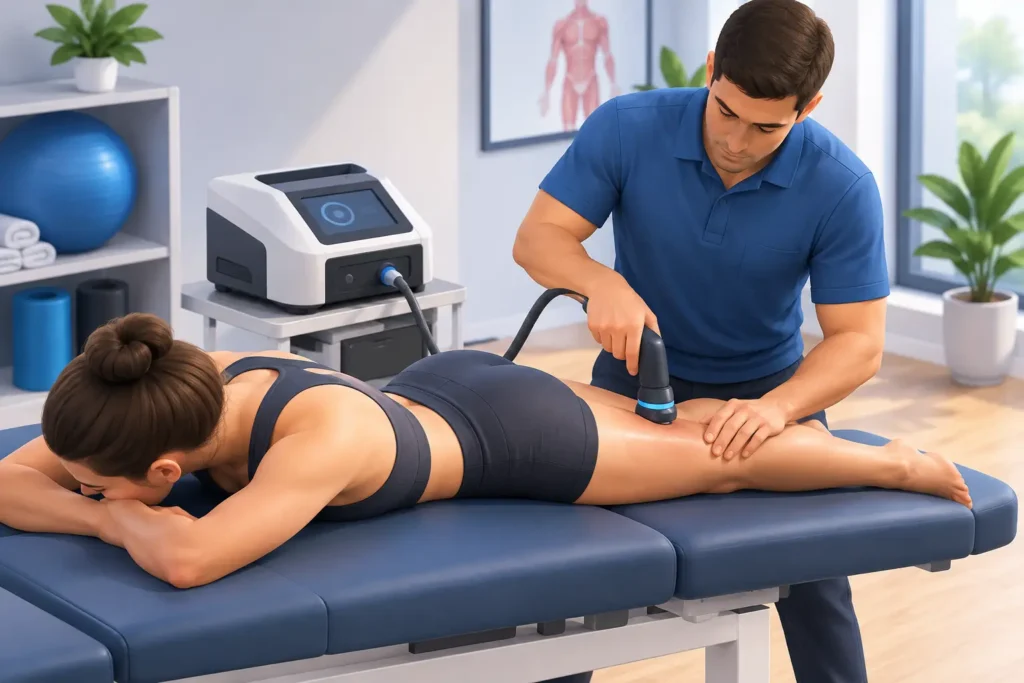
A hard workout, a long run, or a demanding week on your feet can leave muscles sore for a day or two. When soreness lingers, keeps returning, or begins changing how you walk, train, sleep, or work, it deserves more than a quick stretch and a foam roller. Winback therapy for muscle recovery is one way a physical therapist can help calm painful tissue and restore movement while addressing the mechanical reason the muscle became overloaded in the first place.
At HigherPhysio, Winback is not used as a stand-alone shortcut. It is integrated with hands-on assessment, myofascial release, functional manual therapy, therapeutic exercise, and movement education. The goal is not simply to make a tight muscle feel temporarily better. It is to help your body move with less strain so you can return to the activities that matter to you.
What Is Winback Therapy?
Winback is a form of radiofrequency therapy, often called TECAR therapy. A therapist uses a device that delivers controlled radiofrequency energy through electrodes or a treatment applicator. Unlike a heating pad that warms the skin from the outside, this treatment is designed to encourage heat and circulatory activity within deeper tissues.
Depending on the setting and the area being treated, the therapist may use capacitive or resistive modes. Capacitive treatment is often useful for more superficial soft tissues, while resistive treatment may be selected for denser structures and deeper areas of tension. Your therapist can also use the treatment without creating a strong warming sensation when a gentler approach is more appropriate.
The experience is generally comfortable. Many patients feel mild, pleasant warmth while the therapist moves the applicator over the area, often while performing hands-on work at the same time. A session should not feel painful or aggressively hot. Your feedback matters throughout treatment, especially if you have a fresh injury, altered sensation, or sensitivity to heat.
How Winback Therapy Supports Muscle Recovery
Muscle soreness and stiffness are not always signs of a damaged muscle. They can reflect an unfamiliar training load, a sudden increase in activity, poor recovery, protective guarding after an injury, or compensation from another part of the body. A calf that will not relax, for example, may be responding to limited ankle mobility, reduced foot support, or a hip strategy that places extra demand on the lower leg.
Winback therapy may support recovery by increasing local circulation, reducing the sensation of stiffness, and making tissue more receptive to manual therapy and movement. For some people, that creates a useful window: the shoulder moves more freely, the hamstring tolerates lengthening, or the low back stops guarding enough to practice a better movement pattern.
That window is valuable, but it is not the whole treatment. If a runner repeatedly develops calf tightness because the foot collapses under load, warming the calf alone will not solve the problem. The clinician needs to assess how the foot, ankle, knee, hip, pelvis, and trunk share force during walking and running. The same principle applies to neck tension from desk work, hip discomfort during squats, and back tightness after lifting.
When heat may help and when it may not
Warmth can be helpful for chronic tightness, muscular guarding, and stiffness that improves once you start moving. It may also be useful before manual therapy or corrective exercise when restricted tissue is limiting a fuller movement.
However, more heat is not automatically better. A newly swollen injury, an acutely irritated area, or a condition involving reduced sensation may require a different approach. Your physical therapist should determine whether Winback is appropriate based on your symptoms, medical history, skin condition, and stage of healing. Good care is specific to the tissue and the person in front of the clinician, not a preset machine protocol.
What a Physical Therapy Session May Look Like
A meaningful recovery session begins with observation, not just placing an applicator on the sore spot. Your therapist may watch you walk, squat, reach, step down, or perform the activity that causes symptoms. They may assess joint mobility, muscle control, posture, breathing mechanics, and the quality of movement above and below the painful area.
If Winback is indicated, it may be applied while the therapist works through myofascial restrictions or guides a joint into a more comfortable range of motion. This can be particularly useful when tissue feels guarded and hands-on treatment alone is difficult to tolerate. The therapist can then reinforce the change with targeted exercise, such as controlled ankle loading after calf work or hip stability training after treatment for an overloaded hamstring.
The most important part often happens after the device is turned off. You may receive a small number of precise exercises, changes to training volume, or practical adjustments for your commute, workstation, footwear, or sleep position. Recovery improves when treatment is carried into daily movement.
Common Reasons People Seek Winback for Muscle Recovery
Winback may be considered for persistent muscle tightness after exercise, muscle strains during the rehabilitation phase, recurrent calf or hamstring discomfort, shoulder and neck tension, low back muscle guarding, and stiffness around the hip or knee. It can also be helpful when pain has led to a cycle of reduced movement and further deconditioning.
For active adults, the appeal is often practical: they want to keep moving without ignoring symptoms until they become a larger injury. For older adults, the priority may be maintaining confidence with stairs, walks, errands, and exercise. In either case, the right plan balances recovery with progressive loading. Complete rest can sometimes be necessary briefly, but too much rest may leave muscles less prepared for the demands that triggered the problem.
What Winback Cannot Do on Its Own
Winback therapy is not a replacement for a diagnosis, progressive rehabilitation, adequate sleep, nutrition, hydration, or sensible training decisions. It cannot repair every injury in one visit, and it should not be presented as a guaranteed way to eliminate pain.
It also cannot correct a movement pattern if that pattern is never retrained. A patient may feel looser after treatment but return to the same overloaded strategy when running, lifting, or sitting at a computer. Lasting change usually requires a combination of tissue treatment, improved mobility where needed, strength and motor control, and a clearer understanding of how to manage activity.
This is why individualized physical therapy matters. Two people with “tight hamstrings” may need entirely different care. One may need gradual loading after a strain. Another may need improved hip control. A third may be dealing with nerve sensitivity or lumbar spine referral rather than a hamstring problem at all.
Is Winback Therapy Safe?
When provided by a trained clinician who screens appropriately and adjusts treatment to your response, Winback is generally well tolerated. Still, radiofrequency therapy is not appropriate for everyone. Tell your therapist about implanted electronic devices, pregnancy, cancer history, blood-clotting concerns, impaired sensation, active infection, recent surgery, or any skin changes in the treatment area.
You should also seek prompt medical evaluation for severe swelling, unexplained redness or warmth, sudden weakness, numbness, loss of coordination, chest pain, shortness of breath, or pain that follows significant trauma. These symptoms need proper medical assessment rather than a recovery treatment.
Making Muscle Recovery More Durable
The best recovery plan is not judged only by how you feel leaving the table. It is judged by whether you can gradually return to the movements that have been limited: finishing a workout without compensating, taking stairs without bracing, sitting through a workday more comfortably, or trusting your body on a weekend walk.
Winback can be a useful part of that process when it is paired with careful clinical reasoning and an active plan. If persistent muscle tightness or soreness is making you change your life around pain, a physical therapy evaluation can identify what is asking too much of your body and create a practical path back to movement.